
What is SYSTEMology?
A proven 7-stage method that turns what’s in your head into documented systems your team actually follows, so the business runs without you.
Here’s what SYSTEMology actually is
SYSTEMology is a step-by-step method, backed by software, books and a global community, that extracts the knowledge sitting in your team’s heads and turns it into documented systems your business can genuinely run on.
It’s built for small business, typically $1M–$15M with 10–50 staff. It assumes you don’t have time to systemise everything yourself, so it hands the work to a Systems Champion instead. The philosophy: process first, then AI. Document the right things, then let AI accelerate.
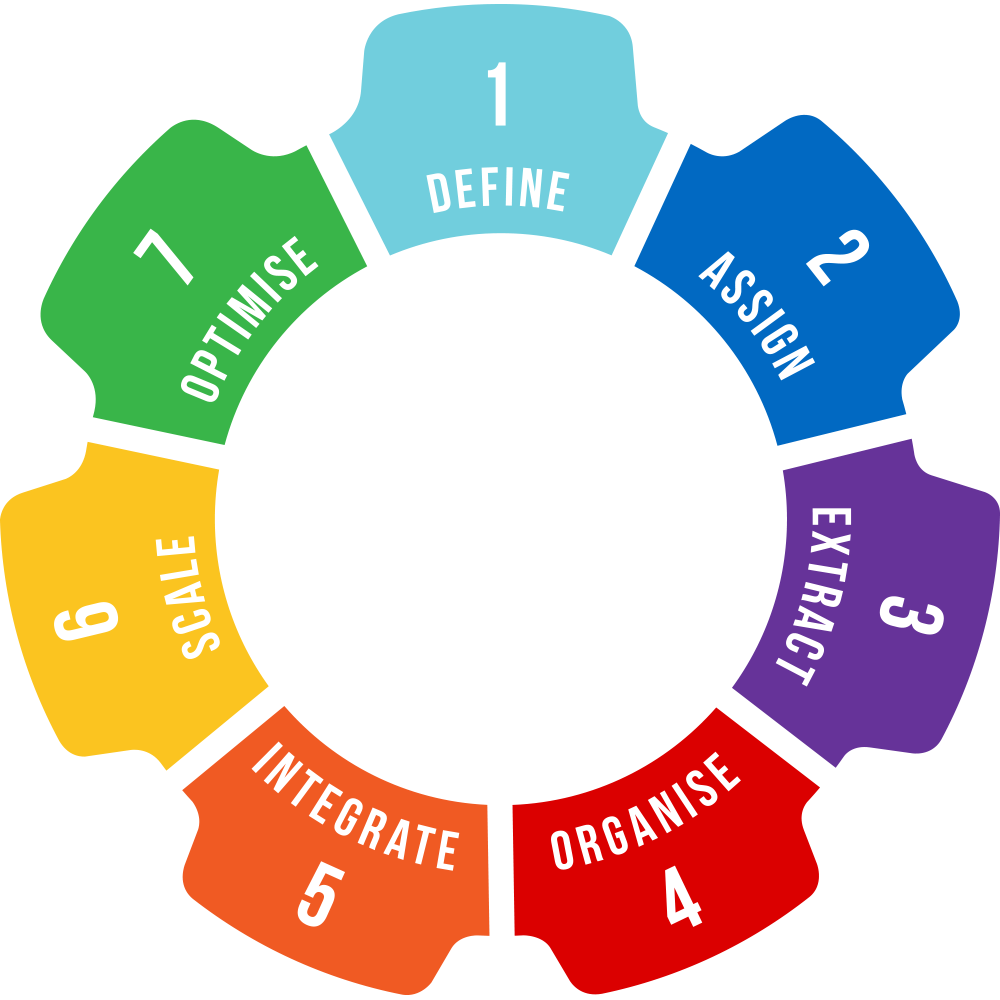
The 7-stage SYSTEMology Method
A sequential process that takes a business from chaos to clockwork. Each stage does one job and hands off to the next. Skipping ahead is the most common way this fails.

Define
Map the Critical Client Flow: one target client, one core product, one journey. This narrows hundreds of possible systems down to the seven to twelve that actually deliver your revenue.
Assign
Work out who already does each of those things well, and which department owns it. You’re locating knowledge that already exists, not inventing it. The goal over time is to remove the owner from every department head seat.

Extract
Record the knowledgeable worker doing the real job, then let AI turn the transcript into a first draft. Always two people in the room: the person who does the task, and the Champion who captures it. Nobody is asked to do their job and write about it at the same time.
Organise
Put every system in one place and wire it into the project manager, so the right system turns up at the point of need rather than sitting in a folder nobody opens.

Integrate
Get the team actually using them. Answer the what’s-in-it-for-me, manage through the systems rather than around them, and name resistance early instead of waiting it out.

Scale
Extend past the Critical Client Flow into finance, HR and management until you reach Minimum Viable Systems, roughly 42 in total: about seven per department across six departments.

Optimise
Only now do you improve. Dashboards, metrics, continuous improvement. Optimising before you have consistency is the classic own-goal, so consistency comes first and better comes second.
Start where the money moves
Stage 1 is the one that decides whether the other six work. Get it wrong and you document the wrong hundred things.
One target client. One core product. One journey. Map how value actually reaches them and roughly ten systems fall out of it on their own. Those are the ones you document first. Everything else waits.
That’s the 80/20 applied to systemisation. You don’t need hundreds of systems to get free. You need the critical few, in order, before anything else.

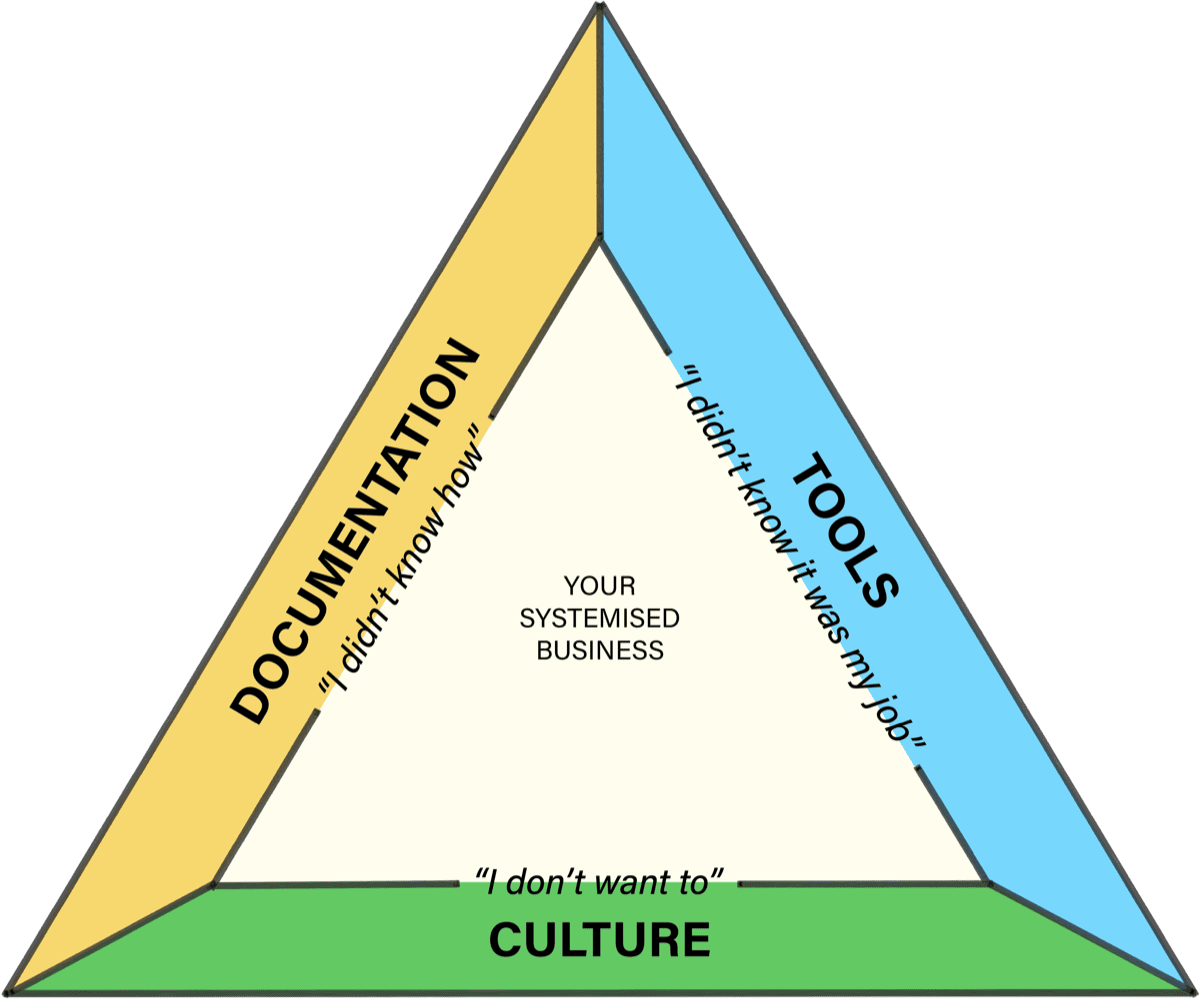
Three pillars that solve three excuses
Most systemisation fails not because the documentation is bad, but because it ignores the human reasons people don’t follow systems. When work doesn’t get done properly it’s almost always one of three sentences.
Documentation
Solves “I don’t know how”Written down simply, by someone other than the person who has to do it. Overview first, detail later. Written for humans, not robots, and built fast with AI.
Tools
Solves “I didn’t know it was my job”The system linked straight into the task, so it surfaces at the moment of need. Documentation in systemHUB, work in the project manager, the two wired together.
Culture
Solves “I don’t want to”Systems in the onboarding from day one, wins celebrated out loud, resistance named rather than waited out. Following the system becomes the default, not the exception.
You are not the person who should write the systems
The single most important role in the method, and the one owners most often try to fill themselves.
The owner has the least patience for documentation and the most to lose from doing it badly. The work belongs to a Systems Champion: someone who sits with each knowledgeable worker, records the real job, and turns it into something the next person can follow.
It’s rarely the most senior person available. At Lime Therapy it was Kaleb, a junior occupational therapist, picked for curiosity and organisation rather than seniority. Invoicing time dropped roughly ninety per cent.
- Organised
- Curious
- Comfortable with technology
- Good with people
Always two people in the room
The knowledgeable worker who does the task, and the Champion who records it. That split is what removes the resistance, because nobody is being asked to do their job and write about it at the same time.
SYSTEMology is right for you if…
You’re in if…
- You run a small business (typically $1M–$15M, 10–50 staff)
- You’re stuck working in the business, not on it
- You want freedom: time, headspace, the option to step away
- You’re ready to delegate systemisation to a Systems Champion rather than do it yourself
- You believe consistency beats brilliance
Probably not for you if…
- You’re a solopreneur with no team yet
- You’re a pre-revenue startup still finding product-market fit
- You’re an enterprise looking for Lean Six Sigma at scale
- You want a quick-fix template pack with no commitment
Real owners. Real freedom.
Three businesses that ran the method end to end.



How SYSTEMology comes together
Four pieces that work as one. Pick your entry point.
How the method works in practice
How long does it take?
Your first documented system inside two weeks. A mapped Critical Client Flow within a month. Real operational impact within three months. A business that can run without you for a week within six to twelve months, depending on your starting state and how much you put into the work.
Does it work in my industry?
SYSTEMology is industry-agnostic. It’s been run across trades, healthcare, agencies, accounting, e-commerce, manufacturing and consulting. Every business has a Critical Client Flow. Finding it is what matters.
Do I need systemHUB to run SYSTEMology?
No. SYSTEMology is the method, and you can implement it with any systems management software. systemHUB exists because we wanted a tool designed specifically for the method, but it isn’t required.
Who actually does the documenting?
A Systems Champion, not the owner. They sit with each knowledgeable worker and record the real job. The owner’s role is to pick the right person, back them publicly, and stay out of the writing.
What if my team resists?
The Three Pillars exist precisely to address that. There’s also a System for Not Following Systems for persistent non-compliance. In practice most resistance evaporates once the documentation is genuinely usable and the Champion is properly empowered.
Where does AI fit?
After the process, never before it. AI is exceptional at turning a recorded interview into a clean first draft, which removes the most painful part of Stage 3. What it can’t do is decide which systems matter. Automate a mess and you get a faster mess.
Every problem in business is a systems problem.
Solve it once and you’re free. Start with the book, it’s on the house, or book a session and we’ll find the one system worth fixing first.
Wondering how this compares to what you’ve already tried? Why SYSTEMology →